




Five Ways John Broadus Impacted My Ministry
Beginning in 2022, when I began research for a biography of John Albert Broadus, until its publication earlier this year, it was my pleasure to spend un-numbered hours with the Southern Seminary founder. Looking back, here are five ways the experience has impacted my ministry.
Beginning in 2022, when I began research for a biography of John Albert Broadus, until its publication earlier this year, it was my pleasure to spend un-numbered hours with the Southern Seminary founder. Looking back, here are five ways the experience has impacted my ministry.
Ambition and Humility
From the time he was a teenager, Broadus wanted to “rise and be eminent” in his generation. As a devoted Christian, he sought to balance his personal ambition with humility and surrender to God’s will. Yet Broadus never lost his thirst for significance. It drove him to become one of America’s greatest preachers, as well as a world-class Greek and New Testament scholar. His ambition motivated him to tackle massive writing projects, like his Commentary on Matthew, and to throw himself into building an institution in the Southern Baptist Theological Seminary that would far outlive him. Whatever he was doing, Broadus exhibited what he called “a quenchless longing to do better.” “Ah! Try to make the best use of your native powers, and of your providential opportunities,” he preached in his famous Yale lectures. “Shame on the young man, yea, and on an old man, who does not burn with desire to improve, in character, knowledge, and usefulness. What is the use of being alive?” Broadus ambition inspires me to make the most of my one, brief life for God’s glory.
Clarity and Simplicity
Broadus is remembered best as a preacher and teacher of preachers. Of all that could be said about his pulpit virtues, his commitment to the clear communication of truth is the most valuable. Though he was brilliant—he could read in twelve languages—he knew he had to get his sermons across to real people, and honed what he called “my clear and simple style.” “A preacher is more solemnly bound than any other person, to make his language perspicuous,” Broadus wrote. “This is very important in wording a law; in writing a title-deed, or a physicians’s prescription, but still more important in proclaiming the word of God, words of eternal life.” He also cautioned his students not to get “educated away from the people.” After years of sequestered study, seminary-trained preachers could easily “get away from all sympathy with the common mind” so that they “don’t know how to talk to people” and “couldn’t present things as the people have to see them.” Broadus was the premier Southern Baptist scholar of his day, but his greatest gift to the seminary may have been keeping the institution grounded in the everyday realities of church ministry.
Perseverance and Loyalty
After the the Civil War, the seminary faculty was divided over whether or not to re-open. It was Broadus’s quiet charge that sealed their commitment: “Suppose we all quietly agree that the seminary may die, but we’ll die first?” The quote has entered seminary lore for good reason: Broadus and the other professors would quite literally keep that oath, each cutting his own life short through their remarkable exertions for the school. Broadus went more than six months at a time without collecting a salary, leaving his family hungry and humiliated. His constant travels to raise funds separated him from his wife and children and further impaired his fragile health. Meanwhile, he had his pick of lucrative and prestigious positions in the church and academy—but he turned every one of them down. “It seems to be my duty,” he told his wife, “and Providence is wiser than I am.” Remaining loyal to the seminary, and to his friend James P. Boyce, required many “bitter sacrifices”—but most worthwhile endeavors do. Would we even remember Broadus if not for his remarkable perseverance and loyalty?
Joy and Hope
Despite the many hardships he endured, Broadus was a warm and joyful man who knew how to enjoy to the fullest the imperfect life God had given him. He loved his large family who, even with the heavy demands of his job, determined to make his home a happy place of Christian nurture. He gardened and exercised. He traveled to new places and attended symphonies. He rode horses, climbed mountains, explored caves, and generally gloried in the wonders of God’s creation. “How delightful it is to drink from the copious flowing stream that has so often done you good through and through,” he wrote from a favorite spot in Virginia. “To climb high mountain sides with fresh and unwearied vigor, and revel in the beautiful scenery; then to sleep, drinking in at every breath the cool, pure mountain air.” He read good books and ate sliced tomatoes, he took walks and laughed with old friends, and he generously invested in the younger generation of preachers and scholars. Whatever its challenges and heartaches, life is always a gift—and Broadus enjoyed it.
Sin and Grace
Broadus was not perfect. To take the most glaring example, at the time that I undertook this project, his name was being scrubbed in many quarters of Southern Baptist life for his slave-holding and white supremacist views. With all the seminary founders, he bought, sold, and owned enslaved African Americans. Like many nineteenth century white Americans, he never questioned his pseudo-scientific views of black inferiority, or his belief that that “the better sort of whites” ought to manage Southern society. Even as we endeavor to understand Broadus in his own context, we should ultimately evaluate him in the light of God’s unchanging Word, and be honest about all the ways in which he falls short. But Broadus’s complexity as sinner and saint also prompt questions for personal reflection. What unexamined assumptions, shaped by the culture rather than the Scriptures, might I hold right now? Onto what subjects and into what dark corners of my own proud heart do I need to shine the antiseptic light of God’s truth? Where do I need to humbly confess my utter dependence on God’s grace?
From the Author
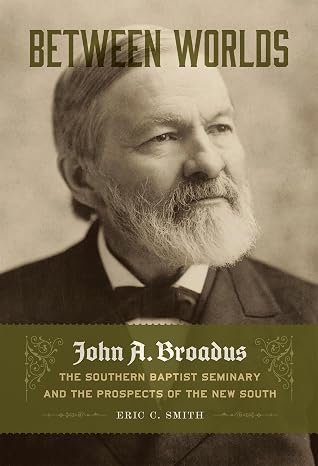
Between Two Worlds
John A. Broadus, the Southern Baptist Seminary, and the Prospects of the New South